Why the Fiscal Policy Multiplier is Zero
Scott Sumner has a new paper published by the Mercatus Centre, Why the Fiscal Multiplier is Roughly Zero. The argument will be familiar to regular readers of his blog, but the paper serves as a nice summary of what has become known as the Sumner critique. As Scott would be the first to concede, this is not a new or unconventional idea, but somehow the economics profession lost sight of this basic insight into monetary-fiscal interactions during the global financial crisis.
The Sumner critique is particularly relevant to a small open economy like Australia, where the entire institutional framework for macroeconomic policy is arguably built around this insight. With a floating exchange rate and an inflation targeting monetary policy, the change in the budget balance as a share of GDP from one year to the next is a macroeconomic irrelevance by design. This allows fiscal policy to focus on microeconomic and supply-side issues.
In testimony before various parliamentary committees, former Treasury Secretary Ken Henry and RBA Governor Glenn Stevens explicitly acknowledged monetary offset in the context of the 2008-09 fiscal ‘stimulus’, but resorted to the argument that it was better to rely on a mix of macroeconomic instruments rather than monetary policy alone, citing alleged adverse side-effects from very low interest rates. In the US context, Sumner notes the real reason for such arguments: politically, the monetary authority cannot be seen to be explicitly undermining the efforts of the fiscal authority.
In Australia, it is often argued that the government should not cut government spending or return the budget to surplus because it would supposedly be contractionary for the economy. This not only ignores the role of fiscal policy within Australia’s macroeconomic policy framework. As Scott notes, the assumed underlying ‘estimates of fiscal multipliers become little more than forecasts of central bank incompetence.’
posted on 13 September 2013 by skirchner in Economics, Financial Markets, Fiscal Policy, Monetary Policy
(0) Comments | Permalink | Main
Scott Sumner Enjoyed His Time in Australia
Scott Sumner enjoyed his time in Australia, presenting at the Centre for Independent Studies’ Consilium conference on the Gold Coast and the Economic Society of Australia (New South Wales) in Sydney. You can read Scott’s account here.
Scott’s presentation covered similar ground to his article in the Winter issue of our journal Policy. I did a video interview with Scott that should be available soon. Watch this space.
Scott says some nice things about the Centre for Independent Studies in the post linked above. Many potential overseas speakers are reluctant to make what is admittedly a long trip to Australia. But take it from Scott, if you come to Australia, we will show you a good time!
One thing I learned as a result of my presentation at Consilium was that then Treasurer Jim Cairns offered the RBA Governorship to Charles Goodhart in the early 1970s (who wisely turned it down). This was quite possibly the only good idea Jim Cairns ever had. So there is at least some historical precedent for my long-standing suggestion for an internationally competitive process for filling senior positions at the RBA.
posted on 29 August 2013 by skirchner in Economics, Monetary Policy
(0) Comments | Permalink | Main
Scott Sumner in Australia
Scott Sumner will be in Australia next month as a guest of the Centre for Independent Studies. He will be attending our Consilium conference on the Gold Coast, but will also be doing a seminar with the Economic Society of Australia (NSW) in Sydney.
Scott has written an article in the latest issue of our journal Policy, ‘A New View of the Great Recession.’ It is an excellent introduction to some of the ideas informing what Lars Christensen has dubbed ‘the new market monetarism.’
I’m also pleased to read that Scott will be attending next year’s Mont Pelerin Society meeting, where he will be on a panel on The Coming Threat of Inflation. As Scott notes on his blog:
The 500 classical liberals in the audience will be surprised to learn that the threat is that inflation will be too low over the next 5 years.
In fact, MPS includes quite a few market monetarists, especially among the younger members (I’m young by MPS standards!) This should not be surprising since the new market monetarism is firmly in the orthodox monetarist tradition of Milton Friedman, one of the Society’s founding members. Unfortunately, many of the older MPS members are still wedded to fighting the inflation battles of the 1970s. They need to move on!
posted on 22 July 2013 by skirchner in Classical Liberalism, Economics, Monetary Policy
(2) Comments | Permalink | Main
Australia as Poster Child for the New Market Monetarism? (March Quarter Edition)
The national accounts were out yesterday, so time to update our graph of the (log) level of nominal GDP relative to its low inflation period trend. The Australian economy still sits 4% below the NGDP level stabilisation benchmark suggested by the new market monetarists, implying that monetary policy has been too tight:
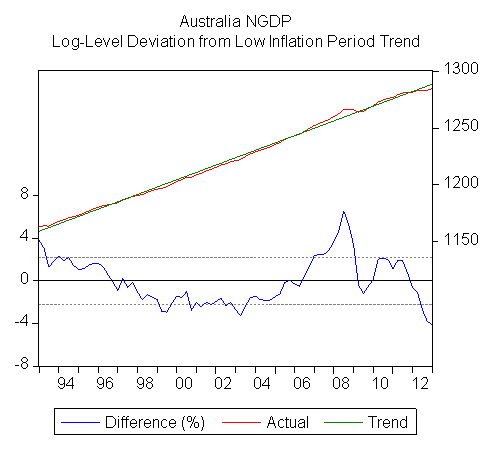
The new market monetarists argue Australia was a poster child for NGDP stabilisation during the financial crisis, but I interpret things differently. Prior to the onset of the financial crisis, inflation was out of control (CPI inflation running at 5%) and nominal GDP growth was running in the double-digits. The financial crisis saved the RBA from having to induce a domestic recession to bring inflation under control. The RBA was most successful when international conditions were doing the work for them.
Lest this look like the luxury of hindsight, I was arguing much the same thing in August 2008.
posted on 06 June 2013 by skirchner in Economics, Financial Markets, Monetary Policy
(2) Comments | Permalink | Main
Foreign Exchange Market Intervention a Risk to Taxpayers
I have an op-ed in the Business Spectator arguing that foreign exchange market intervention is a risk to taxpayers who would be better served if the RBA matched its foreign currency assets and liabilities. I also debunk the notion that Australia is a victim of a ‘currency war’:
It has been argued that Australia is somehow a victim of a ‘currency war’ being waged between foreign central banks engaged in quantitative easing. Yet there is nothing unusual about the effects of quantitative easing on exchange rates.
Quantitative easing is simply a change in the operating instrument of the central bank, from a price variable (the official interest rate) to a quantity variable (base money).
In itself, quantitative easing tell us nothing about whether central bank policy is easy or tight. Low inflation and low interest rates in countries like Japan and the United States imply policy settings are if anything too tight, not too easy.
The exchange rate is just one of the channels through which a change in monetary policy is transmitted to the rest of the economy and quantitative easing does not fundamentally alter this transmission mechanism.
In previous decades, Australians worried about a low exchange rate and capital flight. In the current international environment, foreign capital inflows are an affirmation of our relatively sound economic fundamentals and not a bad problem to have.
posted on 18 April 2013 by skirchner in Economics, Financial Markets, Foreign Investment, Monetary Policy
(0) Comments | Permalink | Main
Why US Monetary Policy is Too Tight
An excellent op-ed by Doug Irwin on why US monetary policy is too tight:
The Divisia M3 and M4 figures for the US money supply, calculated by the Center for Financial Stability, show that the money supply is no higher today than in early 2008. For all the fretting about the Fed’s accommodative policy, the money supply has barely increased and is way off its previous trend. This represents a very tight policy compared to Friedman’s rule that growth in the money supply should be limited to a constant percentage. The lack of growth in the money supply is an important reason why US inflation and inflationary expectations remain under control. The Federal Reserve Bank of Cleveland’s latest market-based estimate of the 10-year expected inflation rate is 1.32 per cent.
posted on 16 October 2012 by skirchner in Economics, Financial Markets, Monetary Policy
(0) Comments | Permalink | Main
Do Australians Make Better Central Bankers?
Does Glenn Stevens know something Ben Bernanke does not? Matt Yglesias seems to think so:
if it’s true that Australia has recession-proofed itself through sound monetary policy, there are lessons that larger countries could be learning here. Heck, we could even be hiring some Australian central bankers to ply their trade in England, Japan, the United States, or wherever.
It is of course very implausible that being Australian in itself makes one a better central banker or the RBA has hit upon a secret formula for conducting monetary policy unknown to the rest of the world (not least because Australian central bankers mostly trained in North America). It is equally implausible that foreign central banks are incapable of observing and learning from the Australian experience.
Nor is that experience as good as Matt suggests. Australia went into the financial crisis with an inflation rate of 5%. In the absence of a severe global economic downturn, the RBA would have been forced to engineer a local one to have much hope of bringing inflation back down to the 2-3% target range. I argued back in August 2008 that monetary policy had been too easy in previous years. The subsequent financial crisis does not change that judgement in any way if you accept that it was an event that could not be forecast.
Glenn Stevens and Ben Bernanke both assumed their respective roles in 2006. Had they swapped roles, would monetary policy and macroeconomic outcomes have been any different in Australia or the US? I think not.
posted on 04 October 2012 by skirchner in Economics, Monetary Policy
(3) Comments | Permalink | Main
Another Shadow RBA Board
Jessica Irvine has rounded-up another Shadow RBA Board, including yours truly. Like the overlapping ANU Shadow Board, the News Ltd version makes normative rather than positive predictions, ie, what the RBA ‘should’ do rather than what it ‘will’ do.
This distinction probably isn’t very meaningful if the starting point for each month’s normative forecast is the existing cash rate. If the starting point re-sets every month, the Shadow rate track cannot deviate far enough or long enough from the actual rate to be economically significant. A Shadow Board needs to take its previous decisions as the starting point and develop an independent interest rate path. Even then, the difference between the Shadow and actual rate tracks may not amount to very much.
The US Shadow Open Market Committee and the UK’s Shadow Monetary Policy Committee were established specifically to critique current policy from a monetarist perspective, as well as advocating reform of existing monetary institutions. This has not prevented significant differences of opinion on these bodies. For example, the Shadow MPC includes supporters and opponents of QE for the UK. As I have argued here previously, QE is an entirely orthodox monetarist policy prescription. It represents no more than a change in operating instrument and QE in itself does not indicate whether policy is easy or tight. Monetary conditions could still be too tight even in the presence of large scale outright bond purchases by the central bank if money demand is strong enough.
We were also asked where we would like to see the official cash rate in 12 months time. My expectation is 100 bp lower than the current rate, but I do not think this will be a particularly easy monetary policy stance. There is a good case to be made that that the world equilibrium real interest rate and potential output have declined as a result of the bad public policy decisions taken globally during and after the financial crisis and now reflected in record low bond yields. How much of this is cyclical and how much becomes permanent depends on where public policy goes from here.
Monetary policy will need to reflect this, but will not do much to address what are ultimately supply-side problems.
posted on 02 October 2012 by skirchner in Economics, Financial Markets, Monetary Policy
(2) Comments | Permalink | Main
Peter Costello and Reserve Bank Transparency
Peter Costello in 2012:
The RBA… as a public institution it must be subject to public scrutiny.
Peter Costello in 2004:
The Reserve Bank of Australia has used powers given to it by Treasurer Peter Costello to issue a “conclusive certificate” to prevent publication of the RBA board’s minutes, saying their release is not in the public interest.
The Reserve Bank’s action on Thursday 25 November came just three days before the start of a hearing in the Administrative Appeals Tribunal in which The Weekend Australian newspaper was set to challenge the RBA’s decision under the Freedom of Information Act not to release the minutes of its meetings and voting records for 2003/04.
posted on 23 August 2012 by skirchner in Economics, Monetary Policy
(0) Comments | Permalink | Main
Euro Crisis Vindicates Friedman’s Big Idea
I have an op-ed in today’s Business Spectator arguing that the euro crisis should be viewed primarily as a vindication of Milton Friedman’s pioneering 1953 essay, ‘The Case for Flexible Exchange Rates.’
Not mentioned in the op-ed, but Friedman’s essay had its origins in a 1950 memo he wrote as a consultant to the Office of Special Representative for Europe, United States Economic Cooperation Administration. The essay references many of the problems with exchange rate regimes in Europe at that time.
posted on 22 May 2012 by skirchner in Economics, Financial Markets, Monetary Policy
(0) Comments | Permalink | Main
Good and Bad Reasons for a Budget Surplus
The government’s stated motivation for returning the budget to surplus next financial year is to give the Reserve Bank ‘maximum room to move’ on interest rates. Yet a fiscal contraction is no more effective in restraining the economy than a fiscal expansion is effective in stimulating it. In an open economy with a floating exchange rate and an inflation-targeting central bank, changes in fiscal policy do not have significant macroeconomic implications. That is why the reaction of financial markets to budget statements is so negligible. The Reserve Bank’s statements also make clear that fiscal policy is a very minor consideration in its decision-making.
During the financial crisis, the government tried to have it both ways, arguing that its fiscal stimulus saved us from recession, but had no implications for interest rates. The second part of the argument was correct, but not the first. If the first part had any truth, then monetary policy must have been much tighter during the financial crisis as a result of the government’s stimulus spending.
The government should have no concern over the macroeconomic implications of changes in the budget balance, so long as it is balancing its budget over time and conducting fiscal policy in a sustainable manner. This should free the government to focus on what fiscal policy can do effectively, namely, changing microeconomic incentives to work, save and invest.
The government and opposition’s mistaken belief in a trade-off between fiscal and monetary policy is dangerous, because it leads to fiscal policy decisions that are more about window-dressing the budget balance and claiming credit for reductions in official interest rates that would have happened anyway, rather than improving incentives. For example, the mistaken belief that tax cuts stimulate demand and lead to higher interest rates can prevent sensible tax reform that has positive implications for the supply-side of the economy. Similarly, the fiscal stimulus of 2008-09 was bad primarily because it misallocated resources. Take away the macroeconomic rationale and the stimulus measures look indefensible on microeconomic grounds, even if the spending had been administered perfectly (which it was not).
A budget surplus target can be defended as a fiscal rule designed to impose additional discipline on government decision-making that might otherwise be absent. But there is no reason to subordinate fiscal policy to monetary policy and fiscal targets should not be pursued at the expense of the microeconomic incentives that are the ultimate source of both economic growth and long-term fiscal sustainability.
posted on 09 May 2012 by skirchner in Economics, Financial Markets, Fiscal Policy, Monetary Policy
(2) Comments | Permalink | Main
Give Bernie 50 and He Will Want 100
Some of us have long memories:
‘No Risk In 1% Rate Cut, Says Fraser’, PAUL CHAMBERLIN, 4 December 1996, The Age:
The former governor of the Reserve Bank, Mr Bernie Fraser, said last night he believed November’s cut in official interest rates should have been doubled. As an overheated dollar retreated in markets yesterday, amid concern about its effect on exports, Mr Fraser said he thought the 0.5 per cent reduction announced last month by the central bank could have been 1 per cent.
“I thought at the time with inflation pretty well under control, very much under control really, and the economy being a bit sluggish in some sectors, that we could have accommodated a 1 per cent cut without any risks,” he said on the ABC’s The 7.30 Report.
Bernie’s comments in December 1996 tanked AUD so hard, the RBA did not cut at that month’s regularly scheduled Board meeting. The RBA waited until 14 December while markets recovered from Bernie’s open mouth operations. So monetary policy ended-up being marginally tighter for longer thanks to Bernie. During his time as Governor, Bernie gave us an average cash rate of 8.7% and an average inflation rate of 3.6%.
posted on 01 May 2012 by skirchner in Economics, Financial Markets, Monetary Policy
(0) Comments | Permalink | Main
Give Austerity a Chance
Robert Carling and I have an op-ed in today’s AFR making the case for fiscal austerity. Drawing on the work of Alberto Alesina and his co-authors, we note that austerity may work politically as well as economically:
Interestingly enough, Alesina and his co-authors also show that fiscal consolidations do not generally reduce the popularity of governments or make it more likely they will lose elections.
Indeed, they go so far as to say that “it is impossible to find systematic evidence of predictable political losses following fiscal adjustments”.
This is entirely consistent with their finding that fiscal consolidations need not have adverse implications for economic growth and may even support growth. Electorates seem to recognise this, even if politicians do not.
posted on 08 February 2012 by skirchner in Economics, Fiscal Policy, Monetary Policy
(2) Comments | Permalink | Main
EMU and International Conflict
Martin Feldstein writing in Foreign Affairs in 1997, demonstrating that the euro crisis was entirely foreseeable:
If EMU does come into existence, as now seems increasingly likely, it will change the political character of Europe in ways that could lead to conflicts in Europe and confrontations with the United States.
The immediate effects of EMU would be to replace the individual national currencies of the participating countries in 2002 with a single currency, the euro, and to shift responsibility for monetary policy from the national central banks to a new European Central Bank (ECB). But the more fundamental long-term effect of adopting a single currency would be the creation of a political union, a European federal state with responsibility for a Europe-wide foreign and security policy as well as for what are now domestic economic and social policies. While the individual governments and key political figures differ in their reasons for wanting a political union, there is no doubt that the real rationale for EMU is political and not economic. Indeed, the adverse economic effects of a single currency on unemployment and inflation would outweigh any gains from facilitating trade and capital flows among the EMU members.
posted on 14 December 2011 by skirchner in Economics, Financial Markets, Monetary Policy
(0) Comments | Permalink | Main
The Irrefutable Logic of Quantitative Easing
A useful thought experiment from Robert Hetzel:
The institutional fact that makes a liquidity trap an irrelevant academic construct is the unlimited ability of the central bank to create money. One can make this point in an irrefutable manner by noting that the logical conclusion to unlimited open-market purchases is that the central bank would end up with all the assets in the economy including interest-bearing government debt, and the public would hold nothing but non-interest-bearing money. Because that situation is untenable, individuals would work backward from that endpoint and begin to run down their money balances and stimulate expenditure in the current period.
posted on 13 December 2011 by skirchner in Economics, Financial Markets, Monetary Policy
(1) Comments | Permalink | Main
Page 3 of 11 pages < 1 2 3 4 5 > Last ›
|